Precision sanding with metal grinding machines
Maximum Precision for Industrial Applications
Das Wichtigste
Precision sanding: Progress through precision
Precision grinding brings workpieces to highly accurate dimensions, ensuring the required thickness, flatness, and surface quality for demanding industrial applications.
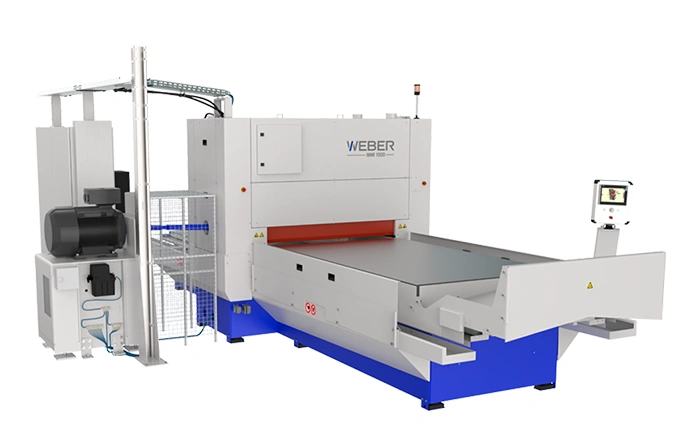
WEBER wide belt grinding machines are designed to process large sheet metal surfaces evenly and precisely. With accuracy of up to 0.02–0.03 mm, our machines deliver consistent results even for large-format workpieces.
Technologies in the field of precision grinding
WEBER combines advanced grinding processes with precise technology to meet even the most demanding applications. Our focus on accuracy, consistency, and attention to detail ensures exceptional surface quality and reliable results.
Discover how WEBER combines innovative technology and engineering expertise to set new standards in precision grinding.
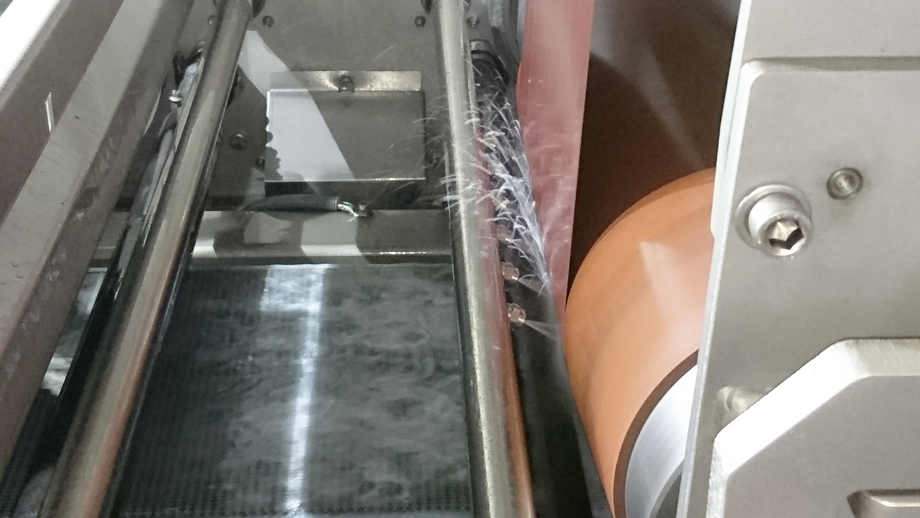
WEBER wet grinding technology combines precision grinding with continuous liquid cooling to achieve highly accurate dimensions and outstanding surface quality. The controlled cooling process minimizes thermal expansion and helps prevent heat-related deformation, making it possible to achieve tight tolerances and consistent results.
Continuous lubrication also reduces grinding wheel wear and supports longer tool life. At the same time, grinding particles are efficiently removed from the work area, helping to prevent scratches and surface defects.
Wet grinding is particularly well suited for demanding applications where precision, dimensional stability, and superior surface quality are essential.
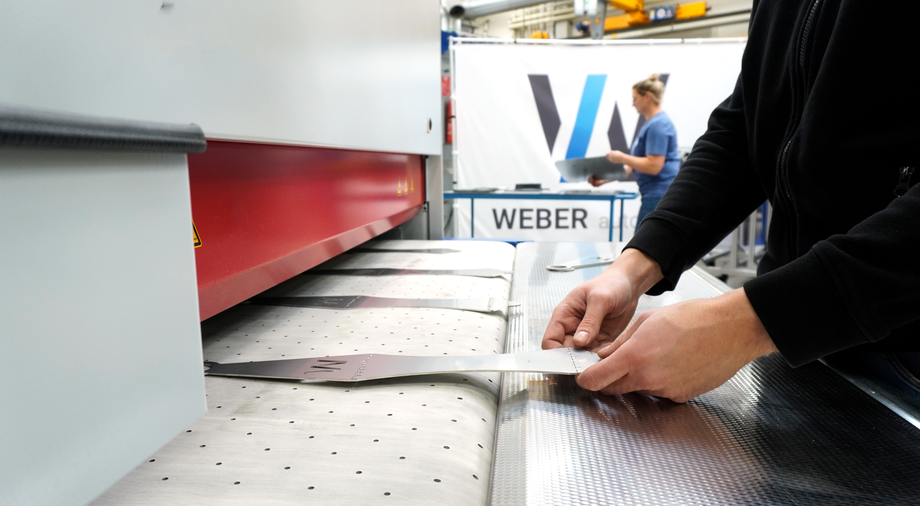
For precision grinding applications, the WEBER fixed transport table provides a stable and highly controlled platform for accurate workpiece processing. Unlike conventional conveyor systems, the precision-guided table ensures consistent movement and reliable positioning throughout the grinding process.
The transport table moves smoothly along precise guide rails, allowing workpieces to be processed in controlled passes. Only a few hundredths of a millimeter of material can be removed with each pass, enabling precise control of the final thickness and surface quality.
Vacuum Table
For non-magnetic workpieces, a vacuum table securely holds the part in place throughout the grinding process. The vacuum creates a firm connection between the workpiece and the table surface for stable and precise processing.
Magnetic Table
Magnetic tables are designed for ferromagnetic materials. Strong magnetic forces securely hold the workpiece in position, providing reliable support during precision grinding.
Together, these table solutions provide the stability and control required for highly accurate grinding of demanding workpieces.
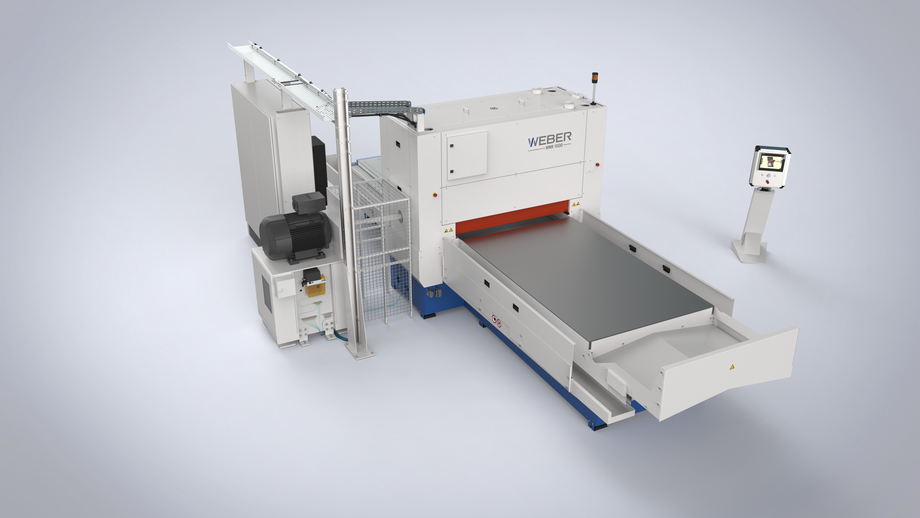
WEBER wide belt sanding machines enable precise and uniform processing of large-format workpieces. The wide sanding belts provide consistent material removal across the entire surface, ensuring a homogeneous finish without unevenness.
By removing only a few hundredths of a millimeter with each pass, the process allows precise control of the final workpiece thickness and surface quality. This makes wide belt sanding ideal for demanding applications requiring accuracy and consistent results across large surfaces.
WEBER software provides intuitive machine control and allows operators to program and automatically run individual grinding profiles. This improves process efficiency and ensures consistent results across different applications.
Precise height adjustment enables accurate positioning of the grinding tools to accommodate different material thicknesses and processing requirements. This ensures controlled material removal and consistent surface quality throughout the process.
Metal grinding technology series
Base frame made of polymer concrete
WEBER precision grinding machines feature a specialized polymer concrete base frame designed for exceptional stability and vibration damping. By minimizing vibrations transferred to the workpiece, the rigid machine base supports precise processing and consistent surface quality.
Combined with high-precision guide rails, the polymer concrete base ensures smooth, stable table movement even under heavy loads. This robust construction contributes to the long-term reliability of the machine and enables highly accurate grinding performance.
Questions about precision grinding:
Precision grinding is a highly accurate machining process used to achieve tight dimensional tolerances and superior surface quality. It plays an important role in industries where precision and consistency are essential, including automotive, aerospace, and tool manufacturing.
WEBER precision grinding technology helps manufacturers produce components with exact dimensions and high-quality surfaces to meet demanding production requirements.
- Increased service life of the workpieces: High surface quality and dimensional accuracy help improve the durability and service life of machined components.
- Improved performance: Precisely ground parts support efficient, reliable performance in demanding applications.
- Reduced wear: Smooth, accurate surfaces can reduce friction and wear between moving components.
- Cost savings: Reduced scrap, rework, and component wear can help manufacturers improve efficiency and reduce overall operating costs.
Precision grinding is used in a variety of industries, including automotive, aerospace, medical, electronics, precision engineering, jewelry, optics and many others that require high-precision components.
- Functionality and fit: In many technical applications, especially in the mechanical engineering industry or for precision mechanical devices, parts must be manufactured very precisely so that they function perfectly and fit together well
- Visual and aesthetic reasons: Precision grinding plays a crucial role in products that also have to meet aesthetic requirements.
- Quality control and safety: Precision grinding is often also a prerequisite for safety and reliability.
Contact, Opening Hours, Locations
Solutions for the future - Contact us
Kontakt